

Time-of-Flight (ToF) Industry News & Updates

Industry leading insights on ToF Technology, 3D Sensing, Robotics, and the future of spatial intelligence.
DMAS2M001 Area-Array dToF Sensor Module: High-Precision SPAD Technology for UAV & Robotics
NEWS

DMAS2M001 Area-Array dToF Sensor Module: High-Precision SPAD Technology for UAV & Robotics

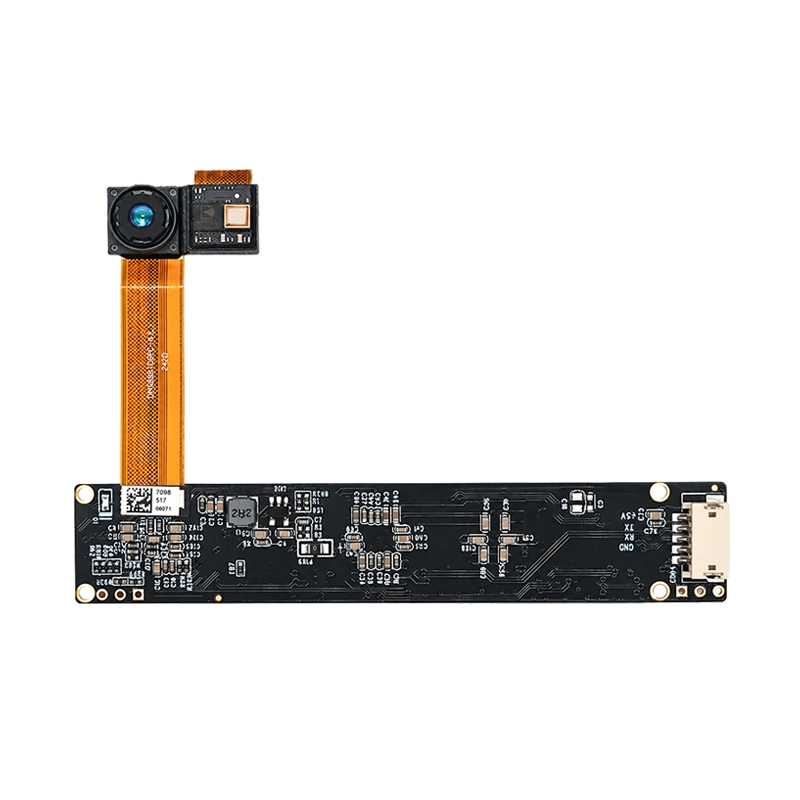
This technical deep dive explores the architecture and performance benchmarks of the DMAS2M001, a cutting-edge Area-Array dToF (Direct Time-of-Flight) Sensor Module designed for next-generation spatial perception in robotics and UAVs.Evolution of Spatial Sensing: The DMAS2M001 dToF ModuleThe demand for high-speed, high-accuracy depth mapping has led to the rise of dToF sensor technology as the industry standard for autonomous navigation. Unlike traditional indirect ToF (iToF) which measures phase shifts, the DMAS2M001 utilizes direct time-of-flight, measuring the literal travel time of photons with picosecond precision.Core Architecture: Hybrid Stacked SPAD & VCSELAt the heart of the DMAS2M001 is a Hybrid Stacked SPAD (Single-Photon Avalanche Diode) detector paired with a high-efficiency 940nm VCSEL (Vertical-Cavity Surface-Emitting Laser).940nm IR Advantage: Operating at the 940nm wavelength ensures the module remains invisible to the human eye while minimizing interference from ambient light.Stacked Silicon: The hybrid stacking process allows for a higher fill factor and faster processing on-chip, reducing the electron-to-digital latency.Precision Performance Across EnvironmentsDynamic Range: It maintains a robust detection envelope from 0.2m to 8m. This range is critical for UAVs requiring both high-altitude ground tracking and low-altitude obstacle proximity alerts.Expansive Field of View (FoV): With a 60°(H) x 45°(V) area-array perspective, the module captures a comprehensive "depth frame" rather than a single point, allowing for complex object recognition and SLAM (Simultaneous Localization and Mapping) integration.Advanced Anti-Sunlight Algorithm: Outdoor operation is often the "achilles heel" of optical sensors. The DMAS2M001 utilizes a proprietary hardware-level algorithm to filter out solar noise, ensuring reliable depth data even in high-lux environments.Technical Specifications Table Feature Specification Technology Area-Array Direct Time-of-Flight (dToF) Light Source     940nm VCSEL Detection Range 0.2m – 8m (Adaptive) FoV     60° Horizontal x 45° Vertical Interface     USB-C / FPC (Flexible Printed Circuit) OS Support Windows, Linux, ARM (Android/ROS) Integration and Application Scenarios1. UAV Obstacle Avoidance & Altitude HoldFor drones, the DMAS2M001 serves as a critical safety layer. The area-array dToF sensor can detect thin wires or branches that single-point lidars might miss. Its light weight and FPC interface make it ideal for integration into compact airframes.2. Autonomous Mobile Robots (AMR)In warehouse automation, the 60° wide FoV allows robots to navigate tight corridors and detect "low-hanging" or floor-level obstacles. The USB-C and ARM support ensure seamless "plug-and-play" capability with popular controllers like Raspberry Pi, Jetson Nano, or industrial PCs running ROS. Why Choose dToF Over iToF?While iToF sensors are common, the dToF sensor technology in the DMAS2M001 offers:Lower Power Consumption: Ideal for battery-operated mobile platforms.Multi-Object Detection: Ability to distinguish between multiple targets within a single pixel path (resolving "pulse piles").Superior Sun Resistance: Essential for any robot transitioning from indoor to outdoor environments.

Read Featured Story
Mar 26, 2026 • 3 MIN READ

Need a Custom ToF Solution?

Speak with our engineering team to find the perfect sensor for your application.

Contact Engineers
Page 2 of 49