
The best ranging technology for autonomous vehicle LiDAR in 2026 is SPAD-based direct Time-of-Flight (dToF), delivering 300-meter detection range, 5-centimeter distance resolution, and reliable operation under 100,000+ lux direct sunlight. Here is how it works, why it outperforms alternatives, and where the technology is headed.
What if the sensor stack that is supposed to keep a Level 4 autonomous vehicle safe at 120 km/h goes blind the moment it exits a tunnel into noon sunlight? That is not a hypothetical. It is why automotive perception engineers are betting the architecture of next-generation LiDAR on direct Time-of-Flight.
What Is dToF and Why Does It Matter for Autonomous Vehicles?
How dToF Works: From Laser Pulse to 3D Point Cloud
Direct Time-of-Flight measures distance by firing a short laser pulse, typically 1 to 5 nanoseconds wide, and counting exactly how long it takes for that pulse to reflect off an object and return to the sensor. The formula is simple: D = (c × Δt) / 2, where c is the speed of light and Δt is the round-trip time. What makes this hard is the scale. Light travels 30 centimeters in one nanosecond. To resolve distance at 5-centimeter intervals, the sensor must measure time differences of approximately 333 picoseconds. That requires single-photon sensitivity, which is where the SPAD comes in.
A Single-Photon Avalanche Diode (SPAD) is biased above its breakdown voltage. A single returning photon triggers an avalanche multiplication, an electron cascade that produces a detectable electrical pulse. A Time-to-Digital Converter (TDC) timestamps that pulse with picosecond precision. By firing thousands of laser pulses and building a histogram of returned photon arrival times, a technique called Time-Correlated Single Photon Counting (TCSPC), the sensor extracts statistically robust depth measurements even in the presence of ambient light noise.
dToF vs. iToF: Two Paths to Depth Sensing
It is worth clarifying the distinction, because "ToF" gets used loosely across the industry.
| Parameter | dToF (Direct ToF) | iToF (Indirect ToF) |
| Principle | Measures photon flight time directly (pulse → return) | Measures phase shift of modulated continuous-wave light |
| Detector | SPAD array or SiPM | CMOS image sensor |
| Max Range | 0.02 m to 300+ m | 0.1 m to ~10 m |
| Sunlight Immunity | Excellent (100,000+ lux) | Moderate (degrades in bright ambient light) |
| Multi-Path Interference | Low (direct timing measurement) | Higher (phase ambiguity from multiple reflections) |
| Resolution | Medium (hundreds to thousands of pixels) | High (VGA and above) |
| Primary Automotive Role | External LiDAR perception (L3+) | In-cabin DMS and gesture sensing |
dToF is the technology for external perception, long-range obstacle detection, free-space estimation, and 3D environmental mapping. iToF dominates the cabin: driver monitoring, occupancy classification, and gesture control. Both are growing fast, but dToF is the one enabling the leap from L2 driver assistance to L3+ autonomy.
The Sensor Stack: How Autonomous Vehicles Perceive the World
Cameras, Radar, LiDAR, and dToF: A Layered Approach
No single sensor solves autonomous perception. The 2026 consensus architecture stacks three complementary modalities:
Cameras provide rich semantic information, object classification, lane markings, traffic signs, signal state, color, and texture. Modern surround-camera configurations feed into Bird's Eye View (BEV) transformer networks that create a unified top-down representation of the scene. But cameras infer depth; they do not measure it. Monocular depth estimation, stereo disparity, and temporal structure-from-motion all work until they do not, blank walls, repeating textures, darkness, glare, and LED flicker each break depth estimation in different ways.
Radar delivers instantaneous range and velocity through Doppler shift. It penetrates rain, fog, and dust better than any optical sensor. But radar's angular resolution is coarse. It cannot resolve whether two adjacent objects are a pedestrian next to a pole or a single wide vehicle.
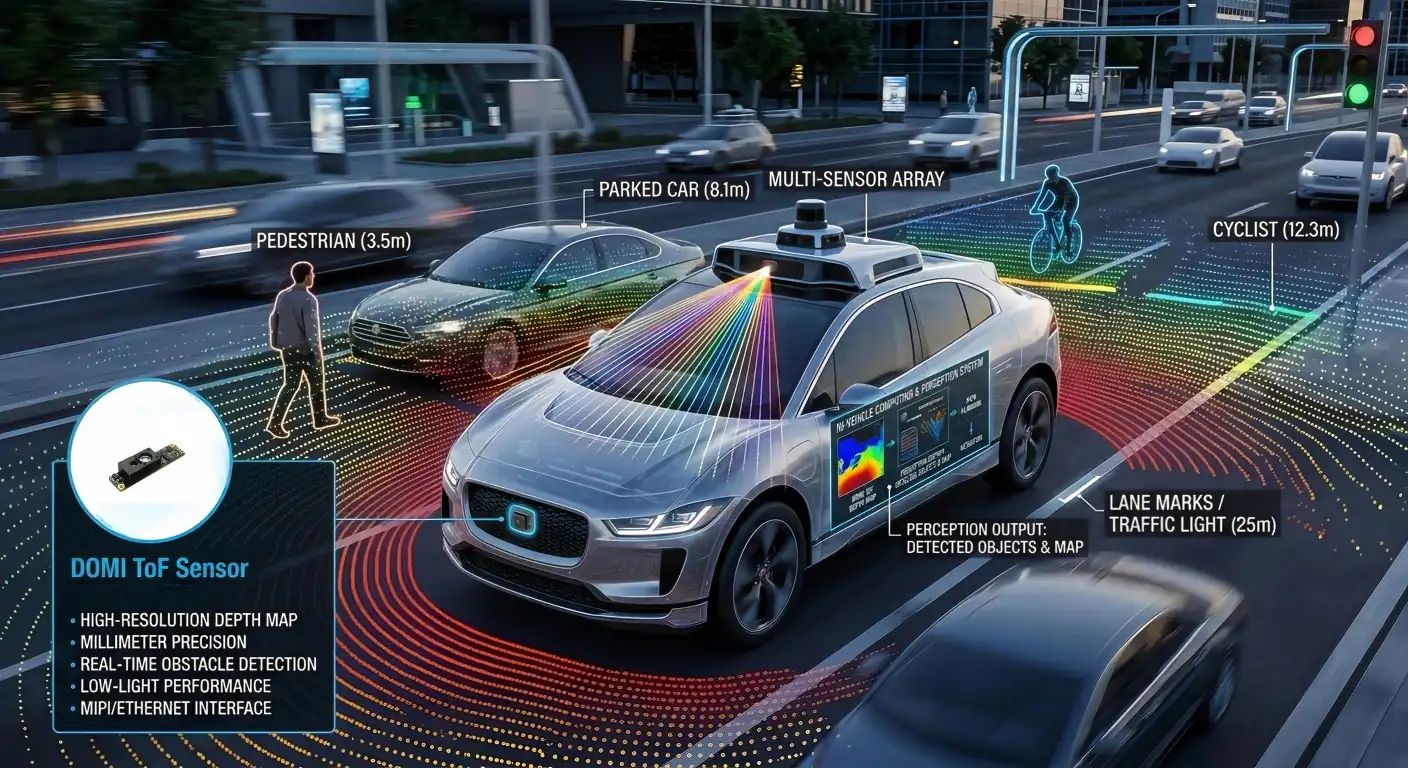
LiDAR, and specifically dToF-based LiDAR, provides metric-depth ground truth. Each point in a LiDAR point cloud has a directly measured 3D coordinate, not an inferred one. In a sensor fusion architecture, dToF LiDAR serves as the geometric skeleton: the precise spatial reference that camera-based semantic labels and radar velocity measurements attach to. When an autonomous vehicle executes an emergency braking maneuver at 130 km/h, the decision cannot rest on inferred depth. It must rest on measured distance. That is the dToF value proposition in one sentence.
Why Sensor Fusion Needs dToF at Its Core
The shift toward Bird's Eye View perception architectures makes dToF more important, not less. BEV transformers project multi-camera 2D features into a unified 3D representation, a projection that requires accurate depth. Without dToF LiDAR providing that depth directly, the BEV pipeline depends entirely on neural depth estimation, which remains unreliable at long range, in adverse weather, and on unfamiliar objects. dToF point clouds serve as depth anchors that calibrate and constrain the BEV projection. The result is safer perception with fewer edge cases.
Explore DOMI's full VCSEL portfolio, the illumination source behind automotive dToF LiDAR. [Browse VCSEL Modules →]https://www.domisensor.com/products/vcsel
dToF in Action: Key Automotive Applications
Long-Range Forward Perception (250–300 m)
At 130 km/h, a vehicle covers 36 meters per second. Detecting a stationary obstacle, a stalled car, fallen cargo, a tire fragment, with enough time to stop requires reliable perception at 250 to 300 meters. The Sony IMX479 SPAD dToF sensor, sampling from autumn 2025, achieves this benchmark: 300-meter maximum range, 5-centimeter distance resolution, 0.05-degree vertical angular resolution, all at 20 frames per second. It detects a 25-centimeter object at 250 meters under 100,000+ lux background light. That object could be a tire on the road. At highway speed, detecting it 250 meters away versus 150 meters away is the difference between a controlled lane change and a collision.
The enabling technology is stacked back-illuminated SPAD design. Sony's IMX479 uses Cu-Cu hybrid bonding to fuse a pixel chip (105 × 1,568 SPAD pixels) with a logic chip containing per-pixel TDCs and histogram processing. The stacked architecture achieves 37% photon detection efficiency at 940 nm, nearly double the previous generation's 24% at 905 nm. Equivalent time sampling at 3 GHz improves depth accuracy beyond what a single-pulse TDC can resolve. The result is a sensor that meets the automotive industry's most demanding long-range perception specification.
Short-Range Surround Sensing and Blind-Zone Coverage
Not every dToF application needs 300 meters. A second critical use case is short-range surround sensing, covering the 0.5-to-10-meter zone around the vehicle for parking, low-speed maneuvering, and blind-spot coverage. Distributed dToF sensor architectures replace a single central LiDAR with multiple compact dToF modules mounted around the vehicle perimeter. Research from EDI Latvia and Fraunhofer demonstrated a seven-sensor dToF array providing 360-degree point cloud registration at 10 Hz with blind-zone coverage down to 0.5 meters, critical for large vehicles like trucks and buses where a single roof-mounted LiDAR leaves significant shadow zones near the vehicle body.
In-Cabin Driver and Occupant Monitoring
While iToF dominates in-cabin applications today, dToF is entering the cabin for specific high-reliability functions. Euro NCAP protocols increasingly mandate driver monitoring systems (DMS) that function reliably across all lighting conditions, from pitch-black nighttime driving to direct sunlight through the side window. dToF's ambient light immunity gives it an edge in these extreme lighting scenarios. The automotive in-cabin ToF sensor market is projected to reach $2.3 billion by 2032, growing at 29.8% CAGR, driven by both iToF for gesture and dToF for safety-critical monitoring.
The Technology Behind Automotive-Grade dToF
The SPAD is the fundamental building block of automotive dToF. Fabricated in CMOS processes, typically 180 nm to 55 nm nodes, depending on the foundry, SPAD arrays now reach hundreds of thousands of pixels on a single die. GlobalFoundries and Egis announced a 55 nm front-side-illuminated SPAD platform in September 2025, integrating SPAD, high-voltage bias, VCSEL driver, MCU, and ranging core on a single SoC. This level of integration is what makes dToF practical at automotive scale: fewer discrete components, lower system BOM, simpler qualification.
Back-side illumination (BSI) with microlens arrays improves photon detection efficiency by moving the wiring stack behind the photosensitive region. Sony's Cu-Cu bonded stacked BSI architecture represents the current state of the art, achieving 37% PDE at 940 nm. For comparison, a conventional FSI SPAD at the same wavelength might achieve 8–12% PDE. That 3× improvement translates directly to longer range at the same laser power.
VCSEL Illumination: The Light Source That Makes dToF Possible
Every dToF sensor needs a pulsed laser source, and in automotive LiDAR, that source is almost always a VCSEL (Vertical Cavity Surface Emitting Laser). Compared to edge-emitting lasers (EELs), VCSELs offer lower temperature sensitivity, simpler driver circuitry, inherent 2D array scalability, and wavelength stability that simplifies the receiver-side optical filter design.
The DOMI DMP300KP delivers 300 W peak power at 905 nm in a 5.2 × 5.2 × 1.55 mm AlN ceramic package, purpose-built for dToF LiDAR illumination. With 5-nanosecond pulse capability, 40° × 30° rectangular spot output, and 20% power conversion efficiency, it provides the high-peak-power, short-pulse illumination that long-range dToF demands. For multi-zone and flash LiDAR architectures, the DMP1KKM 16-channel VCSEL array delivers 70 W peak per channel with individual channel drive, enabling addressable illumination patterns for adaptive scanning and region-of-interest sensing.
When Marcus's LiDAR startup in Shenzhen switched from an EEL-based illumination design to the DMP300KP VCSEL in late 2025, they eliminated three discrete components from their transmitter BOM: the thermoelectric cooler, the temperature compensation circuit, and the external photodiode monitor. The VCSEL's inherent temperature stability, wavelength drift of just 0.07 nm/°C versus 0.3 nm/°C for their previous EEL, meant the receiver's narrowband optical filter stayed matched to the emitter across the full –40°C to +85°C automotive temperature range. Total transmitter BOM dropped 22%. Time to AEC-Q102 qualification shortened by three months.
Stacked Chip Architecture and On-Sensor Processing
A 520-pixel SPAD array running at 20 fps with multi-hit TCSPC histograms generates enormous raw data, tens of gigabits per second. Transmitting that off-chip to a central processor is impractical in an automotive environment where cable weight, connector cost, and EMI all constrain data bandwidth. The solution is on-sensor processing: the logic chip in the stacked pair performs histogramming, peak detection, and range calculation on-die, outputting only the final depth map rather than raw photon timestamps. Sony reports approximately 98% data reduction through on-chip processing on the IMX479. ST's VL53L9CX goes further, embedding the entire dToF post-processing pipeline, including multi-zone ranging, ambient rejection, and confidence scoring, on the sensor itself, enabling direct connection to a low-cost MCU via I²C.
Get the full specifications on DOMI's [DMS604 dToF Ranging Sensor](https://www.domisensor.com/products/tof-sensor/603-dtof-ranging-sensor-dms604): 58 m indoor, 35 m outdoor at 100 klux, 50 Hz update rate.
Challenges and Solutions for Automotive dToF Deployment
Sunlight Interference and Multi-LiDAR Crosstalk
Sunlight is the adversary of every optical sensor. At 100,000 lux, bright noon sunlight, the background photon flux dwarfs the returning laser signal by orders of magnitude. dToF's advantage is temporal: the laser pulse is nanoseconds wide, and the SPAD only listens during a narrow time gate corresponding to the expected target range. Ambient photons outside that gate are ignored. Multi-frequency operation and adaptive coincidence detection further suppress ambient noise. Research from HKUST demonstrated reliable 20-fps depth imaging at 34 meters under 79 klux and single-point detection to 80 meters under 103 klux using time-coded TCSPC with adaptive coincidence thresholds, techniques that are now being integrated into production silicon.
A newer challenge emerges as dToF LiDAR becomes common: mutual interference between LiDAR units on different vehicles. When two dToF sensors operating at the same wavelength fire pulses that reach each other's receivers, the result is ghost points, phantom objects that appear in the point cloud. Time-coded TCSPC addresses this by applying pseudo-random temporal modulation to each sensor's laser pulse train, making each unit's signal statistically distinguishable from every other unit's interference. Think of it as CDMA for light.
Cost, Qualification, and Supply Chain at Scale
The dToF LiDAR market is on an aggressive cost-reduction curve. The 2026 market of $5.26 billion, representing roughly 840,000 units, is dominated by premium L2+ and L3 vehicles with BOM headroom for multiple sensor modalities. But the 2032 projection of $52.19 billion implies tens of millions of units annually, which requires per-unit costs to drop by an order of magnitude. Several trends converge to make this possible: monolithic SPAD+VCSEL driver SoCs reducing component count, 55 nm and below CMOS nodes lowering die cost per pixel, and vertically integrated suppliers, like DOMI, which designs both VCSEL chips and SPAD-based ranging modules under one roof, compressing the supply chain margin stack.
Automotive qualification remains the gating factor. AEC-Q100 Grade 2 (–40°C to +125°C), ISO 26262 ASIL-B(D) functional safety compliance, and AEC-Q102 for optoelectronic components each require 12–18 months of qualification testing. The sensor suppliers shipping automotive-grade dToF in 2026, Sony, STMicroelectronics, and the foundry ecosystem around GlobalFoundries, began their qualification programs in 2023–2024. New entrants face a 3-to-4-year gap from first silicon to automotive production readiness.
The Road Ahead: dToF and the Future of Autonomous Driving
Market Growth and Technology Convergence
The numbers tell a clear story. dToF LiDAR is the fastest-growing segment in the automotive sensor market, with 46.6% CAGR through 2032. L2+ vehicle dToF LiDAR penetration reaches 16.3% in 2026 and is projected to exceed 40% by 2030. Europe leads with over 50% of the automotive ToF sensor market, driven by Euro NCAP safety mandates and strong OEM adoption of L3 highway pilot systems. Asia-Pacific follows at approximately 25%, with Chinese manufacturers accelerating domestic dToF supply chains through companies like DJI Livox, RoboSense, and Hesai.
Technology convergence amplifies this growth. dToF sensors are becoming smaller, more integrated, and more power-efficient, which expands their addressable market beyond automotive into adjacent applications like autonomous mobile robots (AMRs), delivery drones, and smart infrastructure. A dToF module designed for automotive blind-zone coverage may also serve as the primary perception sensor for a warehouse AMR or a last-mile delivery robot. This cross-pollination accelerates volume production, which drives costs down for everyone.
Explore more in the [DOMI ToF Knowledge Hub](https://www.domisensor.com/blog/tof-knowledge-hub) for deep dives on SPAD technology, VCSEL design, and sensor integration guides.