The best VL53L4CD replacement is the DOMI DM0301 — a pin-to-pin compatible 1D ToF sensor with 3.8x longer range (5 m vs 1.3 m), full 100k lux sunlight immunity, and lower total system cost. This article covers the full comparison, migration steps, and when each sensor is the right choice.
Key Takeaways
– DM0301 is a pin-to-pin VL53L4CD replacement — same 4.4 x 2.4 x 1.0 mm footprint, no PCB redesign needed
– 3.8x longer range: 5 m vs 1.3 m, letting you cover more area with fewer sensors
– 100k lux sunlight immunity keeps readings stable in direct sun, where VL53L4CD degrades
– Lower total BOM cost through competitive unit pricing, fewer sensors per install, and zero redesign expense
– Trade-off: 20 mm minimum range vs VL53L4CD’s 1 mm — matters for very close proximity applications
DM0301: The Best VL53L4CD Replacement for Longer Range and Lower Cost
When evaluating a VL53L4CD replacement, three factors matter most. First, how much of your existing hardware you can keep. Second, whether the performance gain justifies the switch. Third, what the real cost difference looks like at production volumes. The DM0301 addresses all three.
Pin-to-Pin Compatible — No PCB Redesign
The DM0301 uses the same 4.4 x 2.4 x 1.0 mm LGA package and identical pin layout as the VL53L4CD. You can swap the sensor on your existing board with zero hardware changes. For teams with certified or qualified designs, this means you keep your layout, your compliance certifications, and your firmware investment. The electrical interface remains I2C, so communication with your existing host MCU stays the same.
Up to 5 m Range — 3.8x Farther
The VL53L4CD reaches about 1.3 m under ideal conditions. The DM0301 extends that to 5 m. This matters in practice for two reasons. First, your system gets more response time — an autonomous mobile robot that detects obstacles at 5 m instead of 1.3 m has more time to stop or reroute. Second, a single DM0301 can often cover the area that would need two or three VL53L4CD units, which directly reduces sensor count and BOM cost.
Works Under Direct Sunlight — 100k Lux Immunity
Ambient light interference is the most common failure mode for 1D ToF sensors. The VL53L4CD offers moderate ambient light immunity. However, the DM0301 maintains stable ranging at up to 100,000 lux — full direct sunlight. This makes it suitable for outdoor-adjacent installations, bright bathrooms with large mirrors, atrium spaces, and anywhere near windows or harsh lighting. No range degradation, no false readings from background IR.
Lower Total Cost in Real Deployments
The cost advantage goes beyond the unit price. Fewer sensors are needed because each unit covers more range. There is no PCB redesign cost, no firmware rewrite, and no re-certification. For volume production, these savings add up fast. Additionally, the DM0301’s lower failure rate in bright environments means fewer field returns and less warranty cost.
VL53L4CD vs DM0301: Full Specification Comparison
| Feature | VL53L4CD | DM0301 |
|---|---|---|
| Max Range | 1.3 m | Up to 5 m |
| Min Range | 1 mm | 20 mm |
| Accuracy | mm-level | < 20 mm |
| Ambient Light Immunity | Moderate | Up to 100k lux |
| Field of View (FoV) | 18 deg | 18 deg / 25 deg |
| Package Size | 4.4 x 2.4 x 1.0 mm | Same |
| Interface | I2C | I2C |
| Pin Layout | — | Pin-to-Pin Compatible |
| Laser Safety | Class 1 | Class 1 |
The DM0301 matches the VL53L4CD on form factor and interface while exceeding it on range and ambient light immunity by wide margins. The one trade-off is minimum detection distance: 20 mm versus 1 mm. For most applications, this difference is not meaningful in practice. For the few where it is, we cover that in the trade-off section below.
For comparison context, the VL53L4CD datasheet is available on STMicroelectronics’ product page. All DM0301 specifications referenced here are from DOMI’s own characterization data collected under the same test conditions where possible.
Migrating From VL53L4CD to DM0301: What Changes
Hardware — Nothing
The DM0301 works as a true drop-in replacement at the PCB level. Same footprint, same pinout, same I2C interface as the VL53L4CD. You do not need to re-spin your board, re-run EMC testing, or update your mechanical design.
Firmware — Minor Updates
While the I2C physical layer is identical, the register map differs between the two sensors. You will need to:
- Update the I2C device address if your DM0301 uses a different default address
- Port ranging configuration registers — initialization sequence and timing parameters differ slightly because of the different SPAD and TDC architecture
- Adjust ranging thresholds if your application previously relied on VL53L4CD-specific calibration values
- Validate timing budgets at your target range and update any timing-critical loops
The firmware changes are typically a few hours of work for an experienced embedded engineer. DOMI provides a migration application note and reference driver code with each DM0301 evaluation kit.
Optical Path — No Change
Both sensors use 940 nm VCSEL emitters and have similar optical requirements. Your existing cover glass, if it was designed for the VL53L4CD, works as-is with the DM0301. Both sensors comply with IEC 60825-1 Class 1 eye-safe laser standards.
Typical Use Cases for the DM0301 VL53L4CD Replacement
Smart Home and Presence Detection
The longer range and high ambient light immunity let one DM0301 cover what used to need two or three VL53L4CD units. Presence detection stays stable whether the room is dark, brightly lit, or partly sunlit through windows. For privacy-compliant smart home applications, the DM0301 provides reliable occupancy data without capturing any identifiable images.
Touchless Faucets and Dispensers
Similarly, bathrooms with large mirrors and bright lighting create tough optical conditions for ToF sensors. The DM0301 keeps ranging accurately in these environments, and its performance holds up even with soap residue or water droplets on the cover glass. The 100k lux rating means it works equally well in windowless bathrooms and in those with direct sun exposure.
Robotics and Automation
With 5 m detection, the DM0301 gives autonomous mobile robots and AGVs more time to react to obstacles. For applications that need wider coverage, the 25 deg FoV option provides broader area detection than the standard 18 deg.
Liquid Level Monitoring
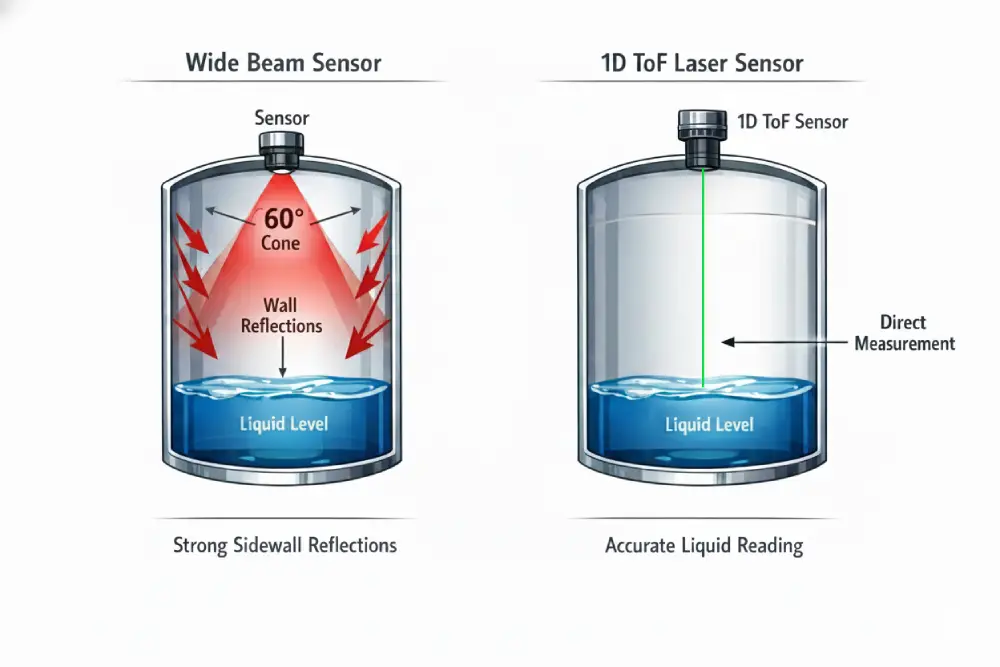
The DM0301 delivers consistent readings through cover glass or transparent container walls. This makes it effective for industrial liquid level sensing, chemical tank monitoring, and automated dispensing systems where a VL53L4CD replacement with better ambient light rejection is needed.
For a deeper look at liquid level applications, see our guide on high-precision laser ranging modules for liquid level sensing.
When to Keep the VL53L4CD
The DM0301 is not always the right choice, however. Stick with the VL53L4CD in these cases:
Ultra-short detection below 20 mm. If your application needs to detect objects within a few millimeters — for example, a print-head gap sensor or a contactless card reader — the VL53L4CD’s 1 mm minimum range is essential.
Millimeter-level precision at close range. If your application requires sub-millimeter accuracy within the 1-50 mm range, the VL53L4CD’s better close-range precision matters.
Deep ST ecosystem integration. Designs that depend heavily on STM32Cube software libraries, ST’s GUI-based calibration tools, or X-CUBE-TOF1 expansion packages may prefer to stay with the VL53L4CD to avoid re-validation effort.
For everyone else, the DM0301 is the better VL53L4CD replacement.
Other VL53L4CD Alternatives Worth Knowing
In contrast to the DM0301’s pin-to-pin approach, two other sensors compete in the 1D ToF ranging category, but neither offers a drop-in VL53L4CD replacement:
- AMS TMF8801 — offers 2.5 m range with good ambient light performance, but requires a PCB redesign as it uses a different package and pinout
- Broadcom AFBR-S50 — targets long-range industrial applications (up to 10 m), but comes at a significantly higher unit cost and larger form factor
For most designs that need a VL53L4CD replacement with minimal integration effort, the DM0301 offers the strongest combination of compatibility, performance, and cost.
Get Started With the DM0301 VL53L4CD Replacement
Visit the DM0301 product page to request a datasheet, order evaluation samples, or contact our engineering team for migration support. We respond to technical inquiries within 24 hours and can provide reference code for common host platforms.
For a complete overview of DOMI’s ranging sensor portfolio, see the ToF sensors product category.
Frequently Asked Questions
What is the best VL53L4CD replacement?
The DM0301 from DOMI is the best VL53L4CD alternative available today. It offers up to 5 m range, 100k lux sunlight immunity, and full pin-to-pin compatibility so you can drop it into an existing VL53L4CD design with no PCB changes.
Can the DM0301 replace the VL53L4CD directly?
Yes. The DM0301 is fully pin-to-pin compatible with the VL53L4CD. It shares the same 4.4 x 2.4 x 1.0 mm footprint, identical LGA package, and I2C interface. The firmware needs a minor register map update, but the hardware is a direct swap.
Is the DM0301 cheaper than the VL53L4CD?
The DM0301 costs less in real-world deployments for several reasons: competitive unit pricing, fewer sensors needed because of longer per-unit range, zero PCB redesign or re-certification cost, and lower failure rates in bright environments that reduce field returns.
What is the maximum range of the DM0301?
The DM0301 reaches up to 5 m, compared to about 1.3 m for the VL53L4CD — a 3.8x improvement. This range is achievable under both indoor lighting and direct sunlight.
Does the DM0301 work in direct sunlight?
Yes. The DM0301 maintains stable ranging at up to 100,000 lux ambient light — full direct sunlight. Most competing ToF sensors, including the VL53L4CD, lose accuracy or fail entirely in these conditions.
What is the trade-off compared to the VL53L4CD?
The only meaningful trade-off is minimum detection range: 20 mm for the DM0301 versus 1 mm for the VL53L4CD. For applications that do not need to detect objects closer than 20 mm, the DM0301 is a straight upgrade on range, sunlight performance, and cost.
The DM0301 is not just a VL53L4CD alternative — it is a practical upgrade. For engineering teams that need longer range, better outdoor reliability, or lower system cost from their VL53L4CD replacement, the DM0301 offers one of the most efficient upgrade paths available.