Why laser ranging is superior for liquid level sensing?
Laser ranging is superior for liquid level sensing because its highly focused light beams are immune to temperature, pressure, and vapor density changes that disrupt acoustic sensors. This non-contact technology provides pinpoint accuracy and a superior signal-to-noise ratio in narrow tanks, eliminating false echoes from sidewalls.
The Bottleneck in Modern Liquid Level Measurement
For industrial automation designers and IoT system integrators, achieving reliable liquid level measurement in volatile environments is a persistent challenge. Legacy mechanical float switches are prone to physical jamming due to residue buildup. Hydrostatic pressure sensors degrade over time when submerged in corrosive chemicals.
Ultrasonic sensors have long been the fallback non-contact solution, but they come with severe limitations. Their wide beam divergence often leads to false echoes bouncing off tank walls. More importantly, acoustic waves rely on the speed of sound, which fluctuates dramatically with ambient temperature, humidity, and vapor density.
Recent laboratory data and field-tested benchmarks highlight this vulnerability: At a 2-meter measuring distance, 1D ToF sensors maintain a <1% error margin, whereas ultrasonic sensors can exhibit up to a 5% error rate in environments saturated with high-temperature chemical vapors.
To engineer out these failure points, designers are increasingly transitioning to 1D ToF (One-Dimensional Time-of-Flight) modules, frequently referred to as Single-point LiDAR.
Technical Deep Dive: How 1D ToF Works in Liquids
The Time-of-Flight principle resolves the fundamental physics limitations of acoustic sensing. A 1D ToF module consists of three critical micro-components: an emitter, a receiver, and a timing controller.
The sensor emits a short pulse of invisible infrared light via a VCSEL (Vertical-Cavity Surface-Emitting Laser). This light travels down to the liquid surface, reflects, and is captured by a highly sensitive SPAD (Single Photon Avalanche Diode) array. The integrated TDC (Time-to-Digital Converter) acts as a microscopic stopwatch, calculating the exact time ( t t ) it took for the photon to return.
Using the constant speed of light ( c c ), the exact distance ( d d ) is calculated as: d = ( c × t ) / 2 d=(c×t)/2 . Because the speed of light remains virtually constant regardless of air pressure, thermal drift, or heavy gas density, 1D ToF provides absolute distance accuracy where other non-contact sensors fail.
Solving Core Liquid Sensing Challenges
- Managing Low Reflectivity Surfaces
One of the historical challenges of optical sensing is dealing with low-reflectivity liquids, such as highly transparent water or dark, light-absorbing oils. Modern 1D ToF sensors solve this through high-gain SPAD arrays and an advanced anti-ambient light algorithm. By utilizing precise cross-talk compensation, the sensor extracts the true returning signal from background optical noise, maximizing the signal-to-noise ratio even when only a fraction of the emitted photons bounce back to the lens. - Navigating Small Apertures and Narrow Tanks
IoT fluid dispensers, chemical dosing tubes, and miniature reservoirs feature extremely tight geometries. Ultrasonic sensors require wide clearance; a typical 40° beam angle will strike the sides of a narrow tube, causing the system to falsely report a full tank. 1D ToF acts as a Single-point LiDAR. With a strictly controlled Field of Illumination (FOI)—often as narrow as 22°—the laser beam shoots straight down to the liquid surface without grazing the sidewalls.
The DM0301 Advantage: A Drop-In Solution for Supply Chain Resilience
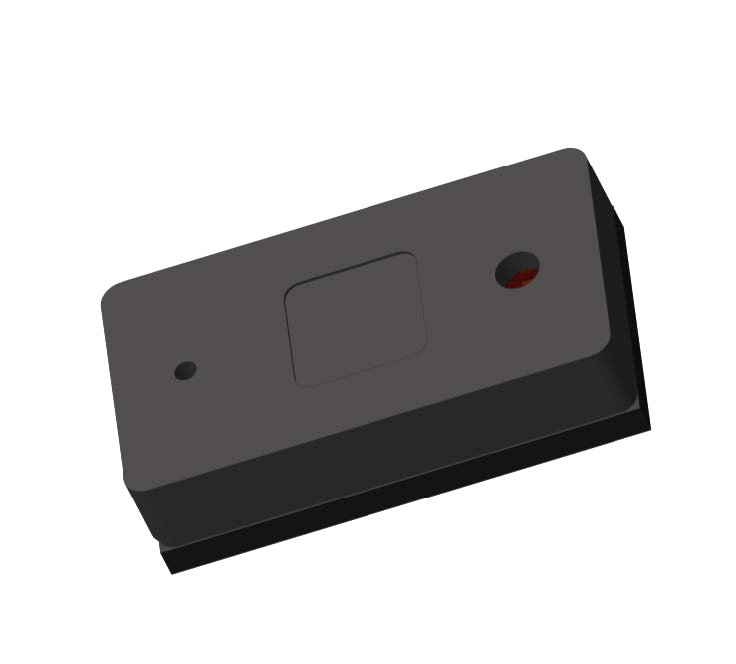
When upgrading from legacy ultrasonic sensors or navigating component shortages, hardware footprint and ease of integration are paramount. The DM0301 is a highly integrated, tiny 1D ToF sensor that combines a VCSEL, SPAD array, micro lens, TDC, and MCU inside a single compact module.
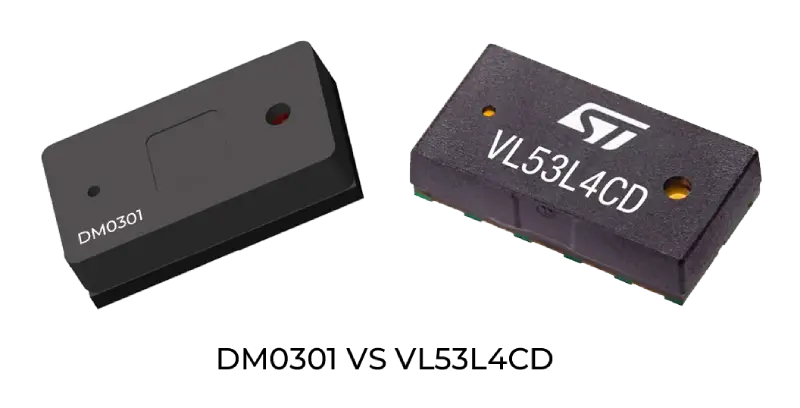
Crucially for engineers facing supply chain bottlenecks or looking to upgrade existing hardware quickly, the DM0301 is pin-to-pin compatible with the VL53L4CD, functioning as an ideal drop-in replacement that requires zero PCB layout changes.
Key Specifications for Industrial Liquid Level Measurement
Delivering highly accurate measurements up to 4000 mm in standard indoor environments (with an absolute maximum range up to 5 meters), the DM0301 brings robust ambient light immunity and extreme power efficiency to battery-operated IoT devices.
| Parameter | Specification |
|---|---|
| Distance Range | 0.02 m ~ 5 m |
| Accuracy | ≤ 20 mm |
| FOI (Field of Illumination) | 22° |
| FOV (Field of View) | 25° |
| Wavelength | 940 nm |
| Package Size | 4.40 mm × 2.40 mm × 1.00 mm |
| Frame Rate | Up to 50 Hz |
| Power Supply | 3.3 V |
| Current Consumption | 0.9 mA @ 1 Hz 17 mA @ 30 Hz |
| Interface | I²C |
| Operating Temperature | -20 °C ~ 70 °C |
| Storage Temperature | -40 °C ~ 85 °C |
| Laser Safety | Class 1 (IEC 60825-1:2014) |
Technology Comparison: 1D ToF vs. Ultrasonic vs. Pressure Sensors
| Feature | 1D ToF (e.g., DM0301) | Ultrasonic Sensors | Submersible Pressure |
| Accuracy | High (≤ 20 mm precision) | Moderate (Subject to thermal drift) | Moderate |
| Narrow Tank Suitability | Excellent (Narrow 25° FOV) | Poor (Sidewall reflections) | Good (Physical immersion required) |
| Vapor / Temperature Impact | None (<1% error) | High (Speed of sound varies) | Low |
| Measurement Method | Non-contact | Non-contact | Contact |
Engineer FAQ: 1D ToF in Liquid Applications
- Does foam affect 1D ToF readings in liquid level sensing?
Yes, thick, highly dense foam on the surface of a liquid can act as a scattering medium. The infrared light may reflect off the top of the foam rather than penetrating it, or it may scatter the signal entirely. To solve this in highly agitated tanks, engineers commonly use a simple stilling well (a narrow PVC tube inserted into the liquid). The DM0301 ToF sensor is mounted at the top of the tube, shooting its narrow beam down to measure the calm, foam-free liquid inside. - How do I need to calibrate the ToF sensor for different liquids?
One of the greatest advantages of 1D ToF is that it requires zero medium-specific calibration. While capacitive sensors must be calibrated for a fluid's dielectric constant, and ultrasonic sensors must be adjusted for the specific gas mixture above the liquid, ToF relies solely on the constant speed of light. Whether your tank contains clean water, diesel fuel, or liquid fertilizer, the sensor outputs accurate, absolute distance via I²C out of the box. - Is the DM0301's laser safe for consumer and commercial IoT devices?
Absolutely. The DM0301 utilizes an invisible 940 nm VCSEL and is rigorously certified as a Class 1 Laser Product under IEC 60825-1:2014 . It is intrinsically safe for human eyes under all normal operating conditions, making it fully compliant for deployment in consumer smart home appliances, automated coffee machines, and commercial fluid dispensers.
Conclusion & Next Steps
Relying on temperature-sensitive acoustic sensors or failure-prone mechanical floats introduces unnecessary risk into modern automation designs. By upgrading to 1D ToF / Single-point LiDAR, you can eliminate thermal drift, ignore chemical vapors, and achieve millimeter-level accuracy in the tightest of enclosures.
If you are currently experiencing supply chain delays with your optical sensors or looking to prototype a next-generation non-contact liquid level monitor, the DM0301 provides an immediate, highly integrated solution.
Ready to eliminate false echoes from your system?
Contact our engineering team today to download the full DM0301 Datasheet, discuss I²C integration, or request free hardware samples for your next pin-to-pin compatible prototype.
Response within 24 hours