
The quest for truly autonomous mobility, spanning from agile unmanned aerial vehicles (UAVs) to collaborative industrial robots (AMRs), hinges on a singular, fundamental capability: precise and robust 3D spatial perception. These machines must perceive, map, and navigate complex, dynamic environments in real-time. While various sensing modalities exist, advanced Laser Distance Sensor technology is rapidly emerging as the definitive standard for robust depth sensing, particularly where precision, speed, and environmental resilience are paramount.
Traditional sensing methods, such as sonar or basic 1D time-of-flight (ToF) rangers, often struggle with complex scenes, multipath interference, and ambient light. A modern Laser Distance Sensor module overcomes these limitations by utilizing sophisticated optical architectures to measure distance with picosecond accuracy. This foundational technical shift, perfectly embodied in sophisticated solutions like the DMAS2M001, unlocks unparalleled performance benchmarks that are redefining the possibilities of autonomous navigation.
Architecting Robust Perception: Inside a High-Performance Laser Distance Sensor
A high-performance Laser Distance Sensor is not merely a single-point measurement device; it is a sophisticated, integrated area-array engine engineered to provide high-fidelity 3D depth data. Its internal architecture leverages cutting-edge components and intelligent algorithms to achieve its definitive precision.
Hybrid Stacked SPAD + 940nm VCSEL: The Core of Precision
At the heart of the DMAS2M001 lies a sophisticated detection engine. It pairs a state-of-the-art detector—a Hybrid Stacked SPAD (Single-Photon Avalanche Diode) array—with a high-efficiency 940nm VCSEL (Vertical-Cavity Surface-Emitting Laser) emitter.
The SPAD technology provides extreme sensitivity, capable of detecting single photons with incredibly low timing jitter. This is critical for maintaining high accuracy across the entire detection envelope. The hybrid stacked design optimizes the fill factor and readout electronics independently, maximizing dynamic range and minimizing signal-to-noise ratio. The choice of a 940nm wavelength operates in a spectrum that is invisible to the human eye, ensuring the system remains non-disruptive, while benefiting from an optimal infrared window for performance.
Optimal Spatial Resolution: 40 × 30 Area-Array Depth Map
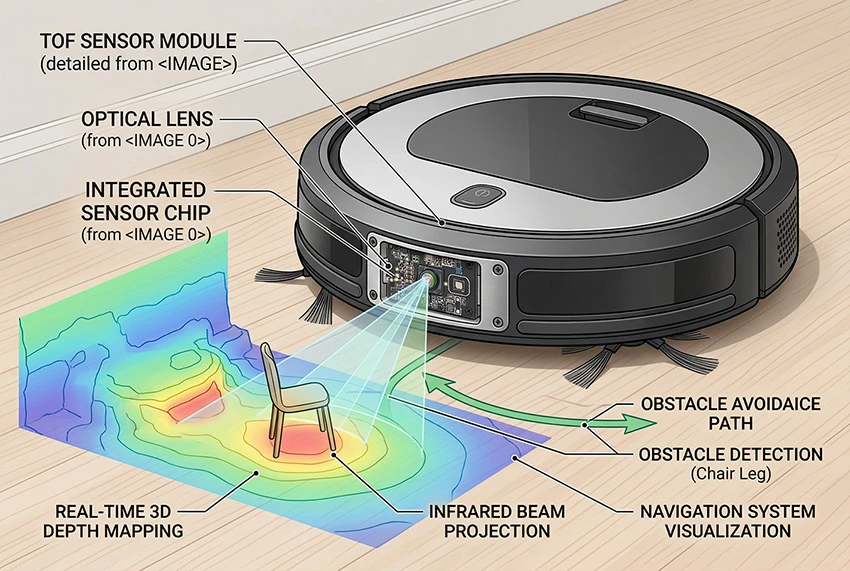
A critical differentiator for this class of Laser Distance Sensor is its area-array configuration. Unlike 1D "rangers" that provide a single distance point within a cone, the DMAS2M001 generates a 40 × 30 area-array depth map (1,200 individual depth points per frame). This resolution strikes the perfect balance between data granularity and processing overhead. It provides sufficient detail to detect complex structures like a wire-mesh fence, a chair leg, or uneven terrain, which are invisible to a single-point sensor. This extensive coverage allows for advanced Simultaneous Localization and Mapping (SLAM) and robust robot (robot collision avoidance) scenarios.
Advanced Environmental Resilience: Proprietary Anti-Sunlight Algorithm
Outdoor operation is a historical challenge for many optical sensors. The intense infrared radiation from sunlight can oversaturate standard detectors. The DMAS2M001 addresses this with a powerful, hardware-accelerated Anti-Sunlight Algorithm. This proprietary technology filters solar noise in real-time, validating its performance across specific reflectivity (10%R–90%R) and light conditions (up to 30 Klux), ensuring that the Laser Distance Sensor provides reliable depth data even in direct outdoor sun environments.
Defining Technical Benchmarks: Precision and Range Analysis
The true power of a Laser Distance Sensor is defined by its reliability and accuracy across diverse conditions. A detailed examination of the DMAS2M001’s core specifications reveals the specific performance metrics that make it indispensable for mission-critical integration.
| Parameter | Specification | Technical Significance |
| Detection Range | 0.2 m – 8 m (@ 30 Klux, 10%R–90%R) | The 0.2m–8m range provides a robust detection envelope, equally effective for close-quarters AMR docking and intermediate-range UAV navigation. |
| Close-Range Accuracy | 0.2 – 1 m: ≤ ±2 cm | Essential for precise UAV landing and tight industrial cobot interaction, ensuring safe operation where spatial margins are minimal. |
| Intermediate Accuracy | 1 – 3 m: ≤ ±3 cm | Ideal for narrow-aisle robot navigation or standard object tracking, maintaining a robust error budget. |
| Extended-Range Accuracy | 3 – 8 m: ≤ 1% (of distance) | For higher-speed UAVs, this progressive accuracy ensures consistent data confidence, e.g., just ±8cm at the full 8m range. |
| Field of View (FoV) | 60° Horizontal × 45° Vertical | The expansive 60° x 45° FoV creates a volumetric point cloud, capturing multi-directional hazards to detect obstacles not just on the ground but at varied heights. |
| Frame Rate | 10 FPS | The robust 10 Hz frame rate is optimized for high-speed dynamic path planning on the UAV platform, providing a real-time data flow for collision avoidance systems |
| Eye Safety | Class 1 Eye Safe (IEC/EN 60825-1) | The sensor is certified for safe operation in public spaces, crucial for universal deployment on service robots and public infrastructure. |
Critical Application Scenarios: Where High-Performance dToF Sets the Standard
The unique technical combination of 8m range, ±2cm precision, and wide area-array data makes the DMAS2M001 the premier Laser Distance Sensor solution for key autonomous verticals.
1. Low-Altitude UAV Obstacle Avoidance & Terrain Following
In the context of UAV obstacle avoidance, the 1,200-point 3D depth map generated by the DMAS2M001 allows a drone to 'see' branches, power lines, and building edges. Its sub-3cm accuracy at close range is critical for precise terrain following (maintaining a constant height above a varied surface) and safe, controlled automated landing sequences.
2. Advanced AMR & Service Robot Navigation (robot collision avoidance)
For Autonomous Mobile Robots (AMRs) operating in dynamic environments like warehouses or hospitals, this Laser Distance Sensor is a safety-critical layer. The 40x30 resolution and 8m range enable complex SLAM and robust robot collision avoidance. It can map narrow aisles, differentiate between static infrastructure and moving human legs, and detect low-profile hazards (like dropped objects or a pallet edge) that other sensors might miss.
dToF Future is Area-Array
For next-generation platforms demanding high-confidence autonomy, the technological shift towards area-array Direct Time-of-Flight is clear. A high-performance Laser Distance Sensor module, validated across rigorous range, reflectivity, and lighting conditions, provides the definitive spatial data needed to power these systems. Its superior precision, environmental resilience (especially against sunlight), and massive data granularity make it the benchmark for real-world depth sensing.