
The DMAS2M001 is not just a spatial sensor; it is a high-performance dToF sensor module meticulously engineered to provide definitive 3D depth data for complex robotic and UAV navigation challenges. Building on its hybrid stacked SPAD and 940nm VCSEL architecture, a deep analysis of its core technical specifications reveals the specific performance benchmarks that make it indispensable for next-generation dToF sensor integration.
This detailed examination defines how the DMAS2M001 sets a new standard for precision, environmental resilience, and operational reliability in the field of autonomous systems.
Core Performance Benchmarks of the DMAS2M001
The true power of a dToF sensor lies in the reliability of its data across diverse conditions. The DMAS2M001’s specifications are defined by rigorous real-world metrics, ensuring its performance is not just theoretical.
Dynamic Distance Range: 0.2m – 8m (@ 30 Klux)
A versatile dToF sensor must maintain a robust detection envelope. The DMAS2M001 delivers a dynamic range from 0.2m (8 inches) to 8m (26 feet).
Environmental Context: This range is validated under challenging conditions of 30 Klux ambient light, demonstrating the sensor's exceptional resistance to sunlight interference—a common failure point for alternative optical technologies.
Target Reflectivity: The specification holds across a standard reflectivity range of 10%R (dark surfaces) to 90%R (white surfaces), ensuring that depth data remains accurate regardless of the target's material properties or lighting.
Industry-Leading Accuracy & Error Profile
Precision is the foundation of effective collision avoidance. The DMAS2M001 defines accuracy through localized error bands, optimized for different operational zones.
Close-Range Zone (0.2 – 1m): Critical for robotic manipulation or UAV landing, the sensor maintains an absolute error of ≤ ±2 cm.
Intermediate-Range Zone (1 – 3m): Ideal for collaborative robots (cobots) or narrow-aisle navigation, the error is capped at ≤ ±3 cm.
Extended-Range Zone (3 – 8m): For higher-speed navigation and advanced mapping, the error remains exceptionally low at ≤ 1% of the distance (e.g., just ±8cm at the maximum 8m range).
This progressive accuracy model ensures maximum confidence where spatial margin of error is tightest.
Optimal Spatial Resolution: 40 × 30 Area-Array
A high-performance dToF sensor does not rely on a single point. The DMAS2M001 generates a 40 × 30 area-array depth map (1,200 individual depth points per frame). This resolution is optimized to strike the perfect balance between data granularity and processing overhead. It provides sufficient detail to detect complex structures like a wire mesh fence, a chair leg, or uneven terrain, enabling robust simultaneous localization and mapping (SLAM) in both standard robot collision avoidanceand advanced UAV obstacle avoidance scenarios.
Key Operational Characteristics
Beyond core accuracy and range, the operational specifications of the DMAS2M001 ensure it integrates seamlessly into the fast-paced world of autonomous hardware.
| Feature | Specification | Technical Significance |
| Field of View (FoV) | 60° Horizontal × 45° Vertical | The 60° x 45° FoV provides comprehensive volumetric coverage, capturing a wide sweep of the environment to detect multi-directional hazards. |
| Frame Rate | 10 FPS (Frames Per Second) | The robust 10 FPS rate is ideal for dynamic path planning, providing real-time data flow for high-speed robotic platforms. |
| Wavelength | 940 nm VCSEL | The 940 nm VCSEL emitter is non-visible to the human eye, ensuring the system remains non-disruptive, while benefiting from an optimal infrared window. |
| Eye Safety | Class 1 (IEC/EN 60825-1) | The module is certified as Class 1 Eye Safe, making it suitable for safe operation in public spaces or around human operators. |
Target Applications: Defined by Technical Rigor
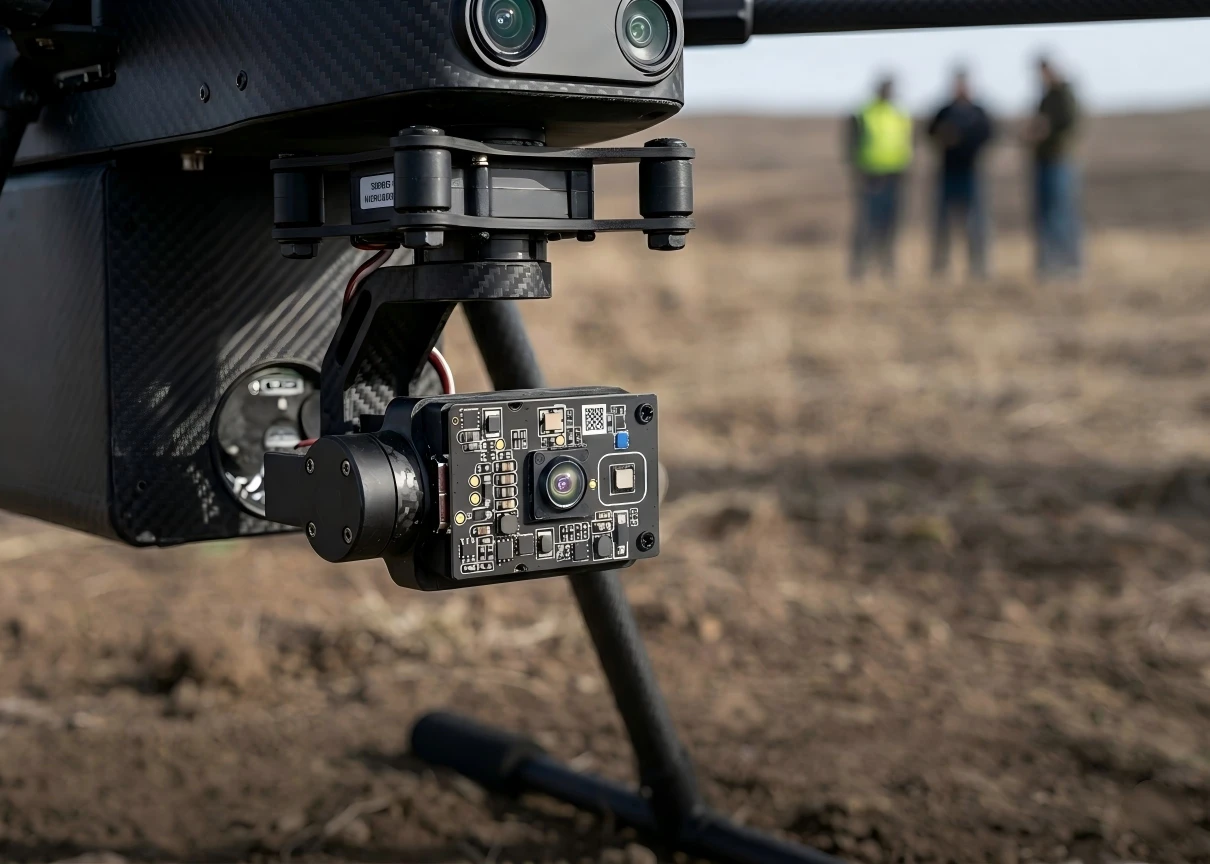
The specific combination of 8m range, ±2cm precision, and wide FoV makes the DMAS2M001 the premier dToF sensor solution for specific mission-critical applications.
1. Low-Altitude UAV Obstacle Avoidance & Terrain Following
In the context of UAV obstacle avoidance, the 1,200-point 3D depth map generated by the DMAS2M001 allows a drone to 'see' branches, power lines, and building edges. Its sub-3cm accuracy at close range is critical for precise terrain following (maintaining a precise height above uneven surfaces) and automated, controlled landing sequences.
2. Advanced AMR & Service Robot Navigation (Robot obstacle avoidance)
For Autonomous Mobile Robots (AMRs) operating in warehouses or retail environments, this dToF sensor is a safety-critical layer. The 40x30 resolution and 8m range enable complex SLAM and robust robot(Robot obstacle avoidance). It can map narrow aisles, differentiate between static infrastructure and moving human legs, and detect low-profile hazards (like a pallet edge) that other sensors might miss.
DMAS2M001 is a technically superior area-array dToF sensor module. By combining SPAD sensitivity with VCSEL power and validating its performance across specific reflectivity and light conditions, it provides the definitive spatial data needed to power the next generation of autonomous systems. Its precision, range, and environmental resilience make it the ideal for real-world depth sensing solutions.