
The rapid proliferation of Autonomous Systems, from agile unmanned aerial vehicles (UAVs) to collaborative industrial robots (AMRs), hinges on a fundamental imperative: flawless spatial perception. These machines must perceive, map, and navigate complex, dynamic environments in real-time. While various sensing modalities exist, Direct Time-of-Flight (dToF module) technology is emerging as the definitive solution for robust 3D depth sensing, particularly where precision, speed, and environmental resilience are paramount.
Traditional indirect ToF (iToF) methods, which infer distance from phase shifts, often encounter limitations in multipath interference, motion blur, and power efficiency. A modern dToF module overcomes these challenges by directly measuring the literal travel time of individual photons with picosecond accuracy. This foundational technical shift unlocks unparalleled performance benchmarks, perfectly embodied in sophisticated solutions like the DMAS2M001.
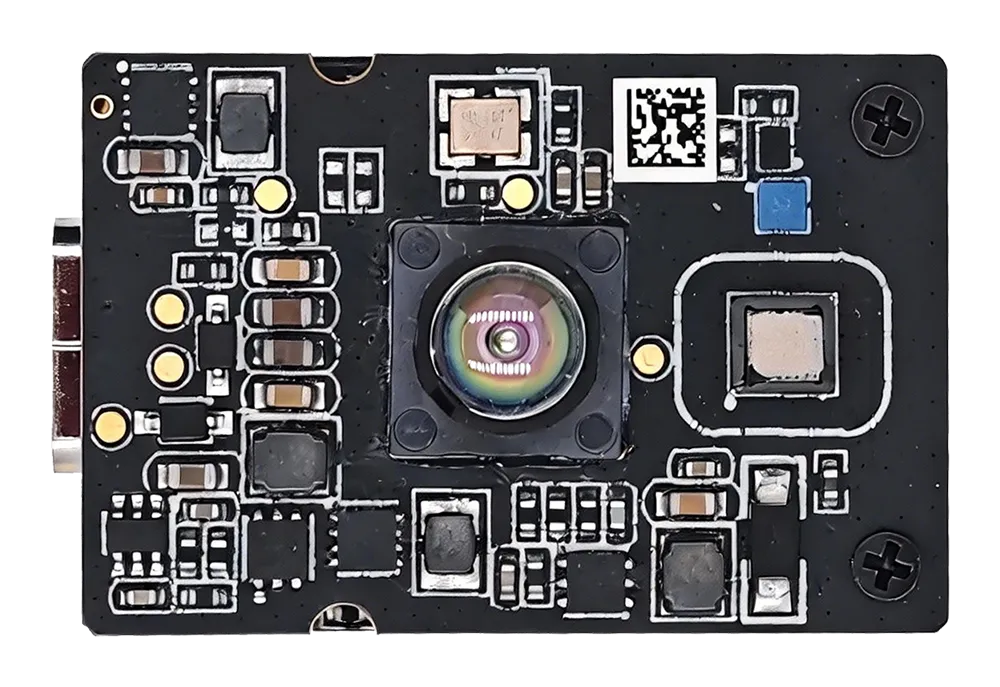
Architecting Robust Perception: The DMAS2M001 dToF Module
The DMAS2M001 is not merely a component; it is a highly integrated, area-array dToF module engineered to provide comprehensive, high-fidelity depth data. Its internal architecture leverages cutting-edge technology to redefine the boundaries of spatial sensing for autonomous platforms.
Hybrid Stacked SPAD + 940nm VCSEL: The Core of Precision
At the heart of this dToF module lies a sophisticated sensing engine. It pairs a state-of-the-art detector—a Hybrid Stacked SPAD (Single-Photon Avalanche Diode) array—with a high-efficiency 940nm VCSEL (Vertical-Cavity Surface-Emitting Laser) emitter.
The SPAD technology provides extreme sensitivity, capable of detecting single photons with incredibly low timing jitter. This is critical for maintaining high accuracy across the entire range. The hybrid stacked design optimizes the fill factor and readout electronics independently, maximizing dynamic range and minimizing signal-to-noise ratio. The use of a 940nm wavelength operates in a spectrum that is invisible to the human eye, ensuring the system remains non-disruptive, while also benefiting from lower solar background noise compared to shorter wavelengths.
Comprehensive Area-Array Scanning: 60°(H) x 45°(V) FoV
Effective obstacle avoidance for an autonomous machine requires more than a single point measurement. The DMAS2M001 dToF module utilizes an area-array configuration, generating a comprehensive depth map (3D point cloud) within a generous 60° Horizontal x 45° Vertical Field of View. This allows an AMR or UAV to perceive a dynamic volume, detecting obstacles not just on a single plane but across varied heights and angles, crucial for mapping thin wires, tree branches, or low-profile floor hazards.
Adaptable Dynamic Range: 0.2m - 8m (Indoor/Outdoor)
A versatile Autonomous System must transition seamlessly between operational environments. This dToF module maintains consistent performance across a wide dynamic range, from close-range precision (0.2m) necessary for AMR docking or UAV landing, up to intermediate-range detection (8m) vital for higher-speed navigation in warehouses or open outdoor spaces.
Advanced Environmental Resilience: Proprietary Anti-Sunlight Algorithm
Outdoor operation is historically the "Achilles' heel" of many optical sensors. The intensive infrared radiation from sunlight can oversaturate standard detectors. The DMAS2M001 incorporates a powerful, hardware-accelerated Anti-Sunlight Algorithm. This proprietary technology filters solar noise in real-time, ensuring that the dToF module provides reliable depth data even in direct, high-lux outdoor environments.
Seamless Platform Integration: USB-C / FPC (Cross-OS Support)
For system architects, ease of integration is a decisive factor. The DMAS2M001 dToF module is designed with flexibility in mind, supporting both rugged USB-C and high-speed, compact FPC (Flexible Printed Circuit) interfaces. Critically, it offers robust driver support across all major operating systems, including Windows, Linux, and ARM architectures, ensuring straightforward deployment on popular robotic controllers like NVIDIA Jetson or Raspberry Pi running ROS (Robot Operating System).
Critical Application Scenarios: Where dToF Modules Set the Standard
The unique performance profile of the DMAS2M001 dToF module makes it an indispensable component in key Autonomous System verticals.
1. Low-Altitude UAV Obstacle Avoidance & Terrain Following
For drones operating near structures, vegetation, or people, reaction time is everything. A high-performance dToF module provides the low latency and high accuracy required for real-time UAV obstacle avoidance. The wide FoV ensures multi-directional perception, and the 8m range allows for advanced path planning. Simultaneously, its precise close-range data is critical for accurate terrain following (maintaining a constant height above a varied surface) and safe, controlled landing sequences.
2. AMR & Service Robot Navigation (robot collision avoidance)
Autonomous Mobile Robots (AMRs) in hospitality, retail, and logistics navigate complex, dynamic indoor corridors populated by people and varied objects. The DMAS2M001 dToF module enables sophisticated Simultaneous Localization and Mapping (SLAM) and robot collision avoidance. It can differentiate between static infrastructure and moving human operators, navigate narrow aisles, and detect floor-level hazards (like dropped objects or cliff edges) that other sensors might miss.
The demand for autonomous machines that are safer, faster, and more versatile is unrelenting. Achieving this level of autonomy requires a fundamental shift towards higher-performance depth sensing. The Direct Time-of-Flight (dToF module) represents that shift, offering superior precision, lower latency, and higher reliability than alternative technologies. With its optimized integration of SPAD sensitivity, VCSEL power, and intelligent algorithms, the DMAS2M001 is a market-ready solution, providing the precise spatial data needed to power the next generation of autonomous systems.