
The quest for truly autonomous mobility, from agile drones to collaborative industrial robots, hinges on a fundamental capability: precise and robust 3D spatial perception. While various sensing modalities exist, Direct Time-of-Flight (dToF) sensor technology is rapidly emerging as the gold standard for real-time distance measurement and depth mapping, particularly in challenging environments.
Traditional sensing methods often struggle with complex scenes, ambient light interference, and motion blur. dToF sensor modules overcome these limitations by directly measuring the time it takes for an infrared light pulse to travel to a target and back to a detector. This "direct" measurement unlocks unparalleled advantages in precision, speed, and reliability.
The dToF Architecture: A Deep Dive into Precision
Unlike Indirect ToF (iToF), which infers distance from the phase shift of a modulated light wave, a dToF sensor utilizes high-precision chronometry to count picoseconds. This fundamental difference enables several key performance benefits:
High Range Resolution: The accuracy of a dToF measurement is determined by the precision of the timing circuitry, not the signal amplitude, making it inherently more accurate and less susceptible to surface reflectivity variations.
Low Latency: With direct photon counting, data processing is fast, enabling extremely high frame rates crucial for collision avoidance in high-speed applications.
Robustness to Interference: Advanced dToF systems employ sophisticated background light subtraction algorithms, making them exceptionally reliable in bright sunlight.
This architecture is perfectly embodied in cutting-edge modules like the DMAS2M001.
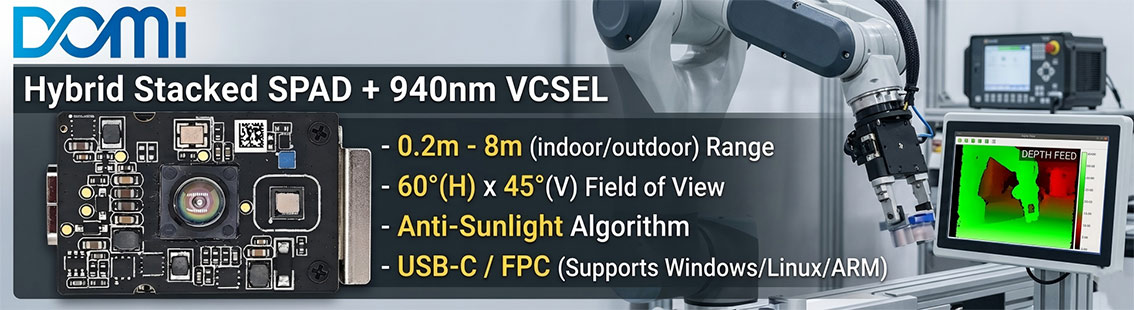
Key Features of the DMAS2M001 dToF Sensor Module
The DMAS2M001 is not just a single-point ranging device; it is a sophisticated, area-array dToF sensor module specifically engineered for robust 3D perception in autonomous systems.
Hybrid Stacked SPAD + 940nm VCSEL: The Core Innovation
At the heart of the DMAS2M001 lies a state-of-the-art detector: a Hybrid Stacked SPAD (Single-Photon Avalanche Diode) array. This detector is paired with a high-efficiency 940nm VCSEL (Vertical-Cavity Surface-Emitting Laser) emitter.
The SPAD technology provides the extreme sensitivity required to detect single photons with incredibly low timing jitter. The hybrid stacking allows the sensor and readout electronics to be optimized independently, maximizing the dynamic range and signal-to-noise ratio. The use of a 940nm wavelength ensures the system operates in a spectrum that is invisible to the human eye and less prone to interference from common indoor lighting.
Expansive 0.2m - 8m Range (Indoor/Outdoor)
A versatile dToF sensor must perform reliably across a wide range of operational distances. The DMAS2M001 offers a dynamic detection range from as close as 0.2m to an impressive 8m. This makes it equally effective for close-quarters obstacle avoidance in warehouses and for long-range navigation in open outdoor environments.
Comprehensive 60°(H) x 45°(V) Field of View (FoV)
Effective collision avoidance requires more than just knowing what is directly in front. The area-array configuration of the DMAS2M001 provides a generous 60° Horizontal x 45° Vertical Field of View. This extensive coverage allows autonomous systems to map a complex 3D volume, detecting obstacles not only on the ground but also at varied heights.
Proprietary Anti-Sunlight Algorithm
Outdoor operation is a historical challenge for many optical sensors. The DMAS2M001 tackles this head-on with an advanced, integrated Anti-Sunlight Algorithm. This proprietary technology filters out the intense IR noise generated by direct sunlight, ensuring reliable depth data in high-lux environments.
Seamless Integration: USB-C / FPC (Supports Windows/Linux/ARM)
For developers, ease of integration is paramount. The DMAS2M001 module supports both standard USB-C and high-speed FPC (Flexible Printed Circuit) interfaces. Furthermore, it offers robust driver support across all major operating systems, including Windows, Linux, and ARM architectures (essential for platforms like Raspberry Pi and NVIDIA Jetson).
Critical Applications: Where dToF Makes the Difference
1. UAV Obstacle Avoidance & Terrain Following
In the high-stakes world of Unmanned Aerial Vehicles (UAVs), reaction time is everything. A high-performance dToF sensor like the DMAS2M001 provides the low latency and high accuracy needed for real-time UAV obstacle avoidance. The wide FoV allows the drone to detect power lines, tree branches, and buildings, enabling complex indoor flight or autonomous mapping of industrial structures. Additionally, its precision at short ranges is ideal for precise terrain following and safe landing protocols.
2. Service Robot & AMR Navigation
Autonomous Mobile Robots (AMRs) operating in dynamic environments like warehouses, hospitals, and retail stores require a deep understanding of their surroundings. The dToF sensor technology enables robust robot (robot collision avoidance) and Simultaneous Localization and Mapping (SLAM). The DMAS2M001 can differentiate between a human operator and a pallet, map narrow aisles, and navigate safely around low-profile objects.
The demand for autonomous systems that can safely and intelligently interact with the real world is insatiable. The Direct Time-of-Flight (dToF) sensor stands as a critical enabler of this future. With its unique combination of SPAD sensitivity, VCSEL power, and intelligent algorithms, the DMAS2M001 module provides a high-performance, integrated solution that is ready to push the boundaries of what is possible in robotics and UAV navigation.