
From robotic vacuums navigating cluttered living rooms to drones maintaining steady altitude and industrial machines ensuring safe operation, the ability to accurately measure distance is fundamental to automation. This critical capability is provided by a range sensor.
But what exactly is a range sensor, and how is the technology evolving to meet the demands of increasingly complex and unconstrained environments?
Defining the Eyes of Automation: What is a ranging sensor?
At its core, a range sensor (also known as a distance sensor or proximity sensor) is a device that measures the distance between itself and a target object without physical contact. This "non-contact" nature is crucial for speed, reliability, and operating in diverse environments.
Most modern range sensors utilize active sensing technology. They emit a signal—such as light (laser, infrared), sound (ultrasonic), or radio waves (radar)—and detect the reflection of that signal back from the target. The sensor then analyzes the characteristics of the reflected signal to calculate the distance.
Common Range Sensing Technologies
While many technologies exist, two dominate the landscape for precise, short-to-medium range applications:
Ultrasonic Sensors: These emit high-frequency sound waves. Distance is calculated based on the "Time-of-Flight" (ToF)—the time it takes for the sound pulse to travel to the object and back. While cost-effective and robust against optical interference (like smoke or transparency), they have limited range, slower refresh rates, and can be affected by ambient noise and air temperature.
Opto-electronic Sensors (ToF & LiDAR): These use light (often infrared lasers) as the sensing medium. They offer significantly higher speed and precision than ultrasonic sensors.
iToF (Indirect Time-of-Flight): Measures the phase shift of a modulated light signal. It is excellent for short distances and generating 3D depth maps but can struggle with multi-path interference and high power consumption.
dToF (Direct Time-of-Flight): Measures the absolute time it takes for an individual photon pulse to travel and return. This technology is gaining rapid traction due to its superior efficiency, long-range potential, and robustness.
The Real-World Challenge: Moving Beyond the Lab
Traditional ToF sensors often perform beautifully in controlled laboratory settings. However, when deployed in the real world, they encounter significant obstacles that degrade performance and reliability:
Sunlight Blinding: Infrared sensors are easily overwhelmed by the high intensity of natural sunlight, making outdoor operation or operation near windows problematic.
Cover Glass Interference (Crosstalk): Placing a sensor behind a protective window (cover glass) is standard design. However, internal reflections within the glass can blend with the target signal, causing severe measurement errors.
Environmental Smudges: Dust, fingerprints, and oil on the sensor's cover glass distort the light path and amplify crosstalk, often rendering standard sensors useless until cleaned.
Enter the DOMI DM0301: Redefining dToF Performance
To overcome these critical limitations, engineers need a sensing solution designed not for the lab, but for the messy, unpredictable real world. This is where the DOMI DM0301 excels.
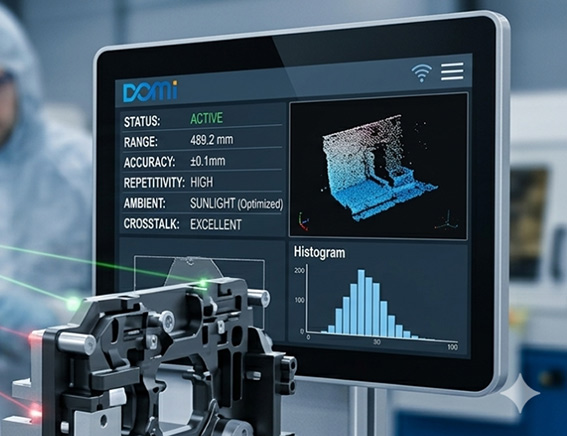
Key Performance Parameters of the DOMI DM0301:
| Parameter | Specification |
| Distance Range | 0.02m ~ 5 m |
| Accuracy | ≤ 20 mm |
| FOI (Field of Illumination) | 22° |
| FOV (Field of View) | 25° |
| Wavelength | 940 nm |
| Package Size | 4.40 mm × 2.40 mm × 1.00 mm |
| Frame Rate | Up to 50 Hz |
| Power Supply | 3.3 V |
DOMI DM0301 doesn't just measure distance; it solves the core problems that have plagued optical range sensing. Here is why it stands out:
1. The Histogram Engine Advantage
The secret to the DM0301’s superior performance lies in its core technology: Advanced dToF combined with a hardware Histogram Engine.
Traditional sensors may only detect the strongest reflection, which might be a reflection from dirt on the cover glass rather than the true target. The DM0301 captures a full "histogram" of photon arrivals over time. Its intelligent algorithms analyze this data to distinguish between the signal from the cover glass, environmental noise, and the true target reflection, even when the target signal is weak.
2. Superior Smudge and Crosstalk Resistance
This histogram capability enables the DM0301's Superior Cover Glass Smudge Resistance. By leveraging its internal auto-compensation algorithm, the DM0301 can mathematically identify and subtract the crosstalk caused by fingerprints or dust on the protective window. This ensures consistent accuracy without the need for frequent manual cleaning or field recalibration.
3. Optimized for Indoor and Outdoor Versatility
With Excellent Ambient Light Immunity, the DM0301 is specifically optimized for operation in high-lux environments, including direct sunlight. This makes it a truly versatile solution, equally capable of navigating a brightly lit showroom or operating reliably near sun-drenched windows.
4. Extended Range and Wider Perspective
The DM0301 extends the standard sensing barrier, offering a 5000mm (5-meter) max detection range. This increased reach provides robots and automated systems with a vital "buffer zone," allowing for faster operation and smoother path planning.
Range sensors are the fundamental building block of spatial awareness. As systems become more autonomous and operate in increasingly unconstrained environments, the demands on these sensors are rapidly evolving. The DOMI DM0301 addresses these demands head-on. By combining dToF precision with a powerful Histogram Engine, sunlight immunity, and smudge resistance, the DM0301 offers a robust, versatile perception solution engineered for the real world.