
The integration of 3D sensing technology into industrial automation has shifted from a luxury to a necessity. Among the various vision technologies, Time-of-Flight (ToF) cameras have emerged as the "eyes" of choice for modern robotic arms due to their high frame rates, compact form factor, and robustness in diverse lighting conditions.
Unlike traditional 2D cameras, ToF sensors measure the time it takes for a light pulse to travel to an object and back, providing a high-precision depth map for every pixel.
1. Presence and Occupancy Detection (Safety & Workflow)
In a busy factory, the first priority is knowing whether a workspace is occupied. ToF cameras provide a reliable "virtual curtain" for robotic arms.
Dynamic Zoning: Unlike static light curtains, a ToF-equipped arm can define flexible 3D safety zones. If a human operator or a stray pallet enters the defined volume, the arm can automatically slow down or halt.
Empty Slot Verification: In automated warehousing, ToF sensors check if a storage bin or a conveyor slot is truly empty before the arm attempts a "place" command, preventing collisions and equipment damage.
2. Precision Bin Picking and Sorting
Traditional 2D vision struggles with overlapping objects or items of the same color (e.g., black rubber parts on a black conveyor). ToF cameras solve this by focusing on geometry rather than contrast.
Overlap Resolution: By analyzing the depth gradients, the robotic arm can identify which part is on top of a pile, allowing for a strategic "pick."
Material Agnostic Sorting: Whether the robot is sorting shiny metal parts or matte plastic components, ToF sensors remain largely unaffected by color or texture, ensuring consistent sorting accuracy at high speeds.
3. Real-time Volumetric Measurement
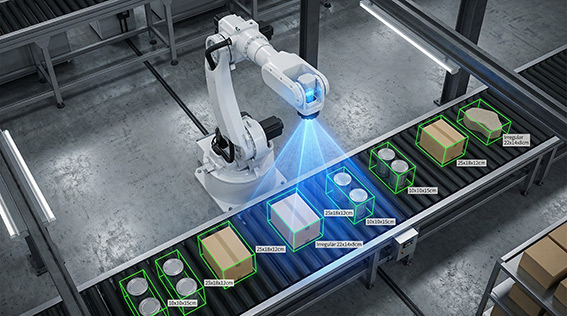
For logistics and packaging, knowing the "how much" is as important as the "where." ToF technology allows robotic arms to perform dimensioning-on-the-fly.
Palletizing Optimization: As the arm picks up a box, the ToF sensor can calculate its length, width, and height in milliseconds. This data allows the control system to calculate the most space-efficient way to stack the item on a pallet.
Irregular Object Cubing: For non-cuboid objects (like bags of grain or casted engine parts), ToF provides a point cloud that calculates the bounding box volume, ensuring the arm uses the correct grip force and placement logic.
4. Why ToF Wins in the Factory
While Stereo Vision and Structured Light have their merits, ToF offers a unique balance for industrial arms:
Feature ToF Benefit
Speed Capable of up to 100+ FPS, matching the rapid cycle times of Delta or SCARA robots.
Simplicity Minimal computational overhead compared to complex stereo-matching algorithms.
Compactness Small enough to be mounted directly on the "end-effector" (the robot's hand) without adding significant weight.
Experience the precision of DOMI ToF cameras. Our high-performance 3D sensing solutions are engineered to seamlessly integrate with industrial robotic arms, delivering unparalleled accuracy in sorting, occupancy detection, and real-time volumetric measurement. Upgrade your automation pipeline with DOMI today.