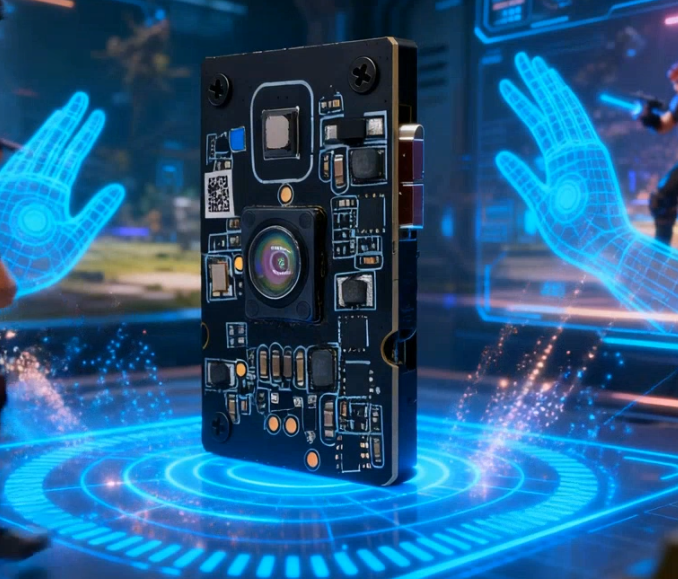
In the pursuit of ultimate immersion, gaming hardware is evolving from 2D screens to 3D spatial experiences. At the heart of this transformation lies dToF (Direct Time-of-Flight) technology.
Unlike standard cameras that "see" flat images, dToF acts as a high-speed "laser ruler," allowing devices to perceive the physical world with incredible depth and precision.
What is dToF?
The principle of dToF is elegantly simple: a sensor emits an ultra-short pulse of light (usually infrared). When this light hits an object and bounces back, the sensor records the exact "travel time" of that trip.Since the speed of light (C) is a known constant, the distance (d) to the object is calculated using the formula:
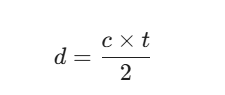
where(t) represents the total round-trip time. While it sounds simple, measuring this at the nanosecond scale requires world-class silicon engineering.
Key Applications in Gaming Hardware
1. AR Gaming: True Digital Persistence
In Augmented Reality (AR) games, dToF enables high-fidelity Environmental Meshing.
Occlusion: Virtual characters can hide behind your actual sofa rather than appearing to float on top of it.
Physics Interaction: A virtual ball can bounce off your specific table edge and roll realistically across the floor.
2. VR/MR Headsets: Spatial Tracking & Hand Input
For devices like the Apple Vision Pro or Meta Quest series, dToF is the backbone of "Inside-out" tracking.
SLAM Mapping: It instantly scans room boundaries for safety.
Sub-millimeter Hand Tracking: Unlike image-based tracking, dToF works perfectly in low light, capturing minute finger movements with near-zero latency.
3. Motion Peripherals: Redefining Interaction
Traditional motion cameras often struggle with "visual noise" like loose clothing or sunlight. dToF sensors use depth data to isolate the human skeleton. Whether you are playing Just Dance or a fitness game, the system tracks your posture with surgical accuracy.
4. Mobile Gaming: Instant Play
High-end smartphones now use dToF (like the LiDAR Scanner on iPhone) to eliminate the need for "calibration." You no longer have to wave your phone around to find the floor; the game world "snaps" into your room instantly.