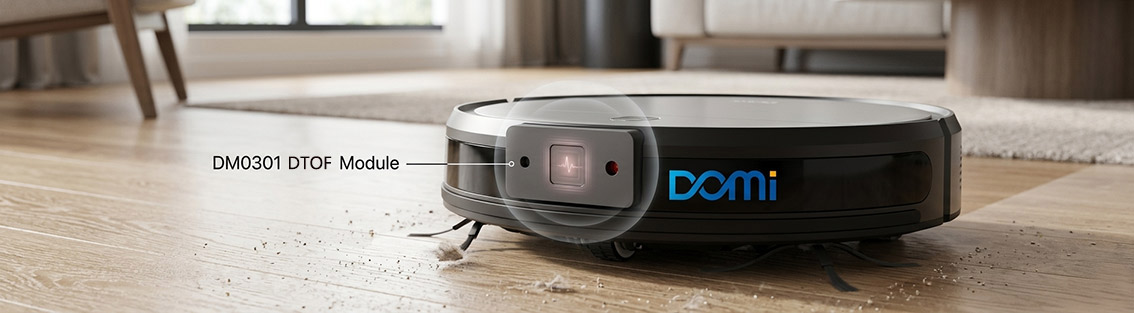
ToF camera and lidar are the same in principle, there is not much difference, ToF camera is more often called depth camera or 3D camera. lidar is also called focal plane imaging lidar. The actual ToF camera is similar to the traditional mechanical scanning lidar. The traditional mechanical scanning lidar is point-by-point scanning imaging, while the ToF camera is a one-shot imaging.
ToF Camera vs. LiDAR: A Technical Deep Dive into 3D Sensing
In the realm of 3D perception and three-dimensional imaging, ToF cameras (Time-of-Flight cameras) and LiDAR (Light Detection and Ranging) stand as pivotal technological solutions. While their core objective—measuring the distance from objects to the sensor—converges, their specific implementation paths and technical parameters exhibit distinct characteristics. The following optimizes the original content with technical deepening, aiming to provide precise technical references for embedded engineers, hardware architects, and others.
Technical Principle Analysis: The Divergence Between ToF and LiDAR
To achieve accurate technical comparison, we must first precisely define the underlying working principles of these two technologies, which is not a simple conceptual simplification:
ToF Camera (Typically iToF): Traditionally, ToF cameras utilize indirect Time-of-Flight (iToF) technology. It emits a continuously modulated sinusoidal infrared signal. The sensor does not directly measure the time-of-flight of individual photons but instead calculates the phase difference between the emitted signal and the reflected signal to derive distance. This method is computationally simpler but highly sensitive to ambient light (e.g., sunlight) and Multipath Interference (MPI). Consequently, iToF is often constrained to short-range (<2m) and high Signal-to-Noise Ratio (SNR) environments.
Imaging LiDAR (dToF): Typically utilizes direct Time-of-Flight (dToF) technology. It emits discrete, high-energy laser pulses (e.g., from a 940nm VCSEL emitter). A SPAD (Single-Photon Avalanche Diode) array at the receiving end precisely measures the entire time-of-flight process from pulse emission to photon reception. Traditional mechanical scanning LiDAR achieves this through continuous point-by-point scanning. "Imaging LiDAR" (also known as "solid-state LiDAR" or "focal plane array LiDAR") performs this measurement simultaneously across all pixels, achieving an effect akin to "one-shot imaging" but with the inherent robust temporal precision of dToF.
Case Study: DM0301—A Miniaturized, Wide Field-of-View dToF Imaging LiDAR
The DM0301 explicitly overcomes the short-range limitation, providing imaging LiDAR performance within a standard, compact camera package. Utilizing dToF technology, it maintains powerful robustness and precision.
| Technical Parameter | Specification | Technical Significance for Robotics & Smart Homes |
| Architectural Class | All-in-One dToF Module | Direct time measurement; robust and precise |
| Max Ranging Distance | 5 meters (indoors) | Extends the functional range beyond typical near-field detection |
| Accuracy / Macro Performance | < 10mm (Macro) | Provides centimeter-level precision for close-range tasks like non-contact gesture control or cliff sensing |
| Ambient Light Immunity | 50,000 lux (1.2m range) | Integrated sunlight suppression algorithms maintain functionality under direct sunlight, addressing a major challenge of iToF |
| Field of View (FoV) / Resolution | Single-zone / Wide FoV | Optimized for reliable detection of obstacles and cliffs across horizontal planes |
Overcoming Distance and Ambient Light Constraints
The DM0301 maintaining robust dToF performance up to 5 meters indoors. This represents a functional upgrade, shifting the technology from simple near-field detection (like mobile phone front-facing sensors) to active long-range navigation (like robotic vacuum cleaners). Crucially, the DM0301 provides a high Ambient Light Immunity of 50k lux at 1.2 meters. This allows robots to navigate between direct indoor sunlit patches and dark areas without sensor blinding or false positives.
Integration, Cost, and Manufacturing Advantages
All-in-One & Manufacturing: The DM0301 integrates the VCSEL emitter, SPAD receiver array, and the entire readout and processing SoC into a 4.4 X 2.4 X 1.0mm package. This level of monolithic integration is a hallmark of semiconductor manufacturing processes, enabling massive scaling and extremely low unit costs, far below those of mechanical scanners.
Package Size & Form Factor: As previously mentioned, the DM0301 is no different in size from an ordinary camera. This "camera-like" form factor is a critical engineering advantage, as it allows embedded designers to replace iToF modules with dToF modules possessing imaging LiDAR capabilities without costly redesigns.
Defining the Future Technological Landscape
In a technical sense, the more accurate perspective is not ToF vs. LiDAR, but iToF (short-range, phase-shift, ambient-sensitive) vs. dToF (robust, long-range, time-gated, scalable).
By utilizing dToF architecture (specifically direct Time-of-Flight imaging LiDAR), the DM0301 is capable of achieving a 5-meter range and extremely high precision (<10mm macro, <20mm full range) within a compact, cost-effective semiconductor package. It effectively bridges this technological gap, providing the robust environmental immunity and long-range capabilities previously exclusive to expensive LiDARs, while maintaining the size, cost, and ease of integration of a simple ToF camera. This makes it a preferred solution for demanding embedded dToF applications in mobile imaging and autonomous robotics.