
what is tof camera?
Time-of-flight (ToF) cameras are comprised of a sensor that uses a tiny laser to fire out infrared light. This light bounces off anything or anyone in front of the camera and back into the sensor.The length of time the light takes to bounce back is measured and that translates to distance information that can be used to create a depth map.
How does a Time-of-Flight camera work?
Time-of-flight camera illuminates the scene with a homogenous flood of light and the camera looks at every individual pixel in the image. The sensor synchronizes with an incredibly sensitive clock that’s capable of measuring tiny variations revealed by the speed of light bouncing back. With depth information assigned to every pixel you get a rich depth map.
To understand how a Time-of-Flight (ToF) camera works, think of it as a high-tech version of a bat’s sonar, but using light instead of sound. While a standard camera captures the "what" (color and texture), a ToF camera captures the "where" (depth and distance).
Here is a technical breakdown of how this technology bridges the gap between 2D imaging and 3D reality.
1. The Underlying Principle: Measuring Light’s Journey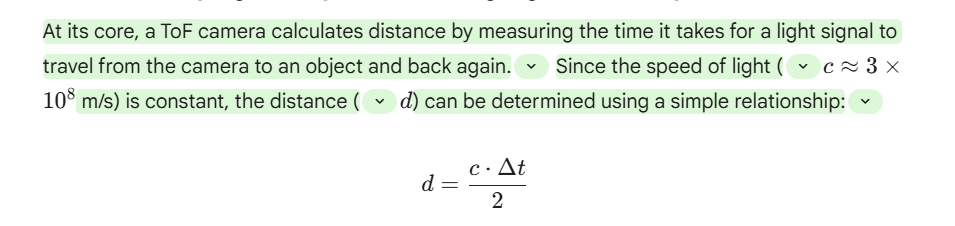
2. Technical Architectures of Time-of-Flight camera
There are two primary ways ToF cameras handle this measurement:
i. dToF (Direct Time-of-Flight)
The camera emits short, powerful pulses of light (usually Infrared). A specialized sensor (often a SPAD - Single-Photon Avalanche Diode) counts the exact nanoseconds it takes for the photons to return.
Pro: Highly accurate over long distances. Example: The LiDAR scanner on the iPhone Pro models.
ii. iToF (Indirect Time-of-Flight)
Instead of a pulse, the camera emits a continuous, modulated wave of light. The sensor measures the phase shift between the emitted wave and the reflected wave.
Pro: Higher resolution and better for close-up scanning.
3. Key Components of a ToF System
A functional ToF system requires three main ingredients
1.Illumination Unit: Usually a VCSEL (Vertical-Cavity Surface-Emitting Laser) or LED that operates in the Near-Infrared (NIR) spectrum (around 850nm–940nm) so it’s invisible to the human eye.
2.ToF Sensor: A specialized CMOS pixel array that can "gate" light at extremely high speeds (sub-nanosecond)
3.Processor: A chip that converts raw phase or pulse data into a "depth map"—a 2D image where every pixel contains a distance value.
4.Applications of Time-of-Flight camera
Time-of-Flight camera is widely used, such as mobile phones.It lends depth information that enhances portrait mode, creating a really accurate bokeh effect with the subject in sharp relief and the background blurred. But that’s not all it can do as part of a phone’s main camera
ToF technology has moved from expensive industrial labs into our pockets and cars
Smartphones: Used for "bokeh" effects in portraits, faster autofocus in low light, and Secure Face ID
Robotics & Logistics: Autonomous Mobile Robots (AMRs) use ToF for obstacle avoidance and pallet detection
Automotive: In-cabin monitoring (detecting if a driver is distracted) and gesture control for infotainment
Augmented Reality (AR): Allowing digital objects to "hide" behind real-world furniture (occlusion).
To build on the technical principles of Time-of-Flight (ToF), it is worth looking at how these concepts are realized in high-performance hardware. A prime example is DOMI (Domi Technologies), a leader in providing industrial-grade and consumer-ready ToF sensing solutions.
DOMI specializes in bridging the gap between raw optical physics and practical, "plug-and-play" modules that work in challenging environments.
Technical Edge of DOMI ToF Solutions
DOMI’s lineup, such as the DMOM2501 and DMOM2508 series, showcases the practical application of the iToF (Indirect ToF) principles discussed earlier
High Precision at Scale: DOMI modules typically achieve sub-centimeter accuracy across their measurement ranges, making them reliable for sensitive tasks like facial biometric or industrial sorting.
Ambient Light Resistance: One of the biggest hurdles for ToF is "noise" from sunlight. DOMI sensors (like the DMAS2M001) are engineered with specialized anti-sunlight algorithms and 940nm VCSELs, allowing them to function even in 100k Lux outdoor conditions.
Compact Integration: DOMI excels at miniaturization. Many of their modules are no larger than a coin (e.g., 21x9x5mm), integrating the sensor, lens, and illumination unit into a single, low-power package.
Core Product Highlights
| Model | Resolution | Range | Key Strengths |
| DMAS2M001 | 40x30 | 0.2m – 8m | ToF Array with high sunlight resistance for UAVs/Drones |
| DMOM2501C | 100x100 | Up to 5m | Balanced performance for robotics and people counting |
| DMOM2508CL | 320x240 | 0.2m – 2m | High resolution for AR/VR and gesture tracking |
Industry-Specific Applications
1. Security & Face ID
Unlike traditional 2D cameras, DOMI ToF sensors capture 3D "liveness." This prevents "spoofing" (where someone tries to trick a lock with a photo or a video), as the sensor recognizes the actual 3D contours of a human face.
2. Smart Logistics & Robotics
In automated warehouses, DOMI cameras enable robots to:
Measure Volume: Instantly calculate the dimensions of a parcel for shipping optimization.
Navigate: Perform SLAM (Simultaneous Localization and Mapping) to avoid obstacles in real-time.
3. Smart Home & Privacy
Because ToF captures depth maps rather than high-resolution color images, it is a privacy-first solution. DOMI sensors can detect if an elderly person has fallen in a room or monitor room occupancy without recording identifiable visual data, ensuring GDPR compliance.

Reference & Source
To dive deeper into the physics and hardware specifications, you can explore these standard industry sources:
Wikipedia: Time-of-flight camera
For detailed datasheets and technical you can visit the official DOMI Sensor technical library:
DOMI Official Website - ToF Product Gallery